Explore IdeasThat Shape the Future.
Dive into expert insights, technology trends, innovative concepts, and deep-dive articles curated by Softuvo’s specialists.

Flutter vs React Native in 2026: Which Framework Should You Build Your App On?
By the time most founders start researching Flutter vs React Native, they've usually already made one decision: they want a single app that works on both iOS and Android.
The confusion starts when they begin figuring out how to build it.
One article says Flutter is the future. Another argues React Native is the safer choice.
The truth is, both frameworks can power successful mobile apps. Companies use them every day to launch products, serve customers, and grow their businesses.
The bigger question is:
What should I build my business on?
Because once development starts, this decision affects hiring, timelines, maintenance, and how easily your product can evolve in the future.
That's what we're going to focus on here.
Getting Familiar with the Two Frameworks
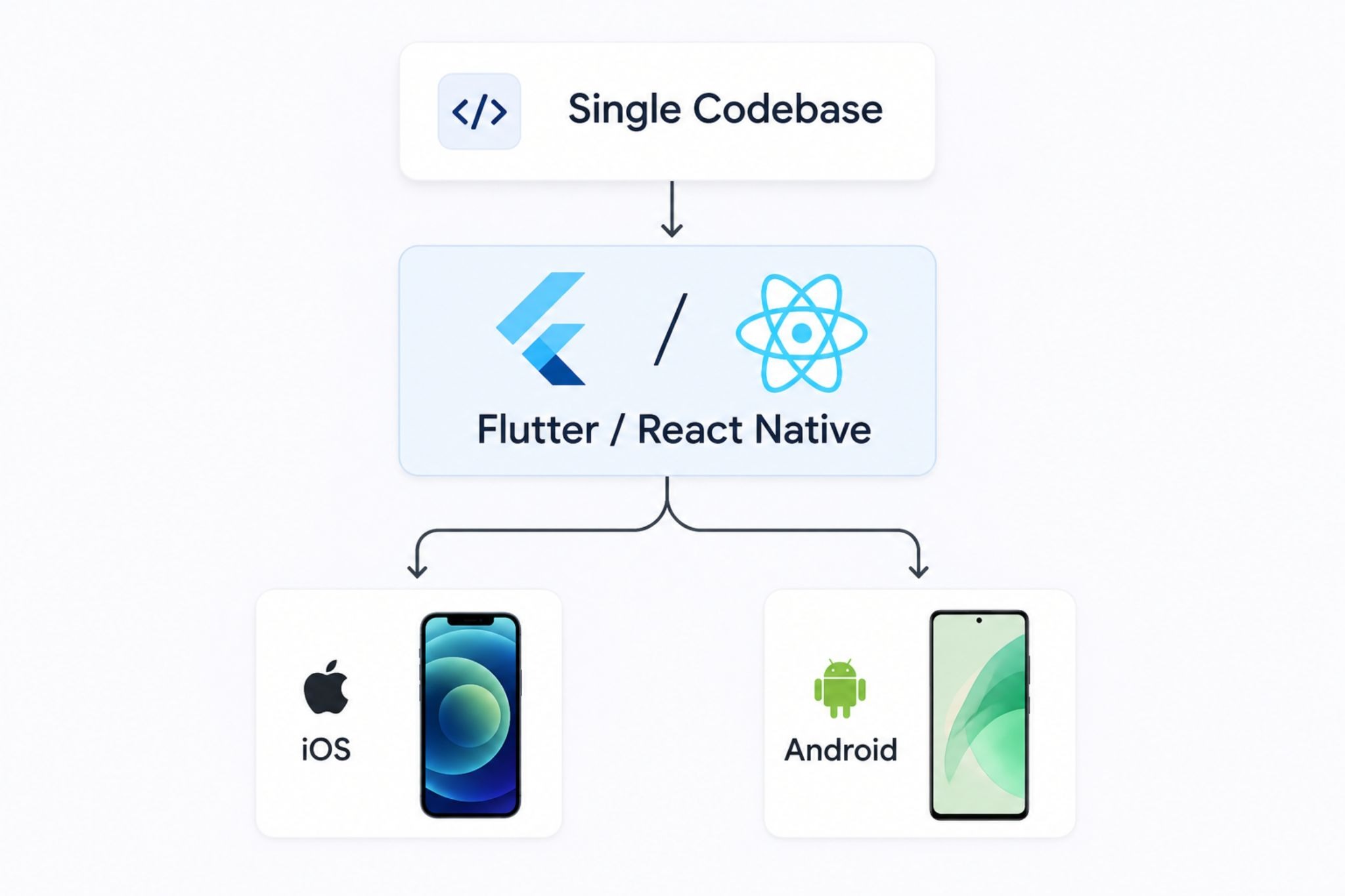
Both Flutter and React Native are cross-platform frameworks. In plain terms, you build the app once, and it runs on both iPhone and Android. You're not paying to build two separate apps from scratch.
Flutter is built and maintained by Google. React Native is built and maintained by Meta. Both are free, open-source, and backed by companies that depend on them internally.
According to the Stack Overflow 2024 Developer Survey, Flutter and React Native rank as the two most used cross-platform mobile frameworks globally, ahead of other alternatives.
That's the baseline. Now here's what actually separates them.
Flutter's Biggest Advantage
Some apps are tools. You open them, do a thing, close them.
Other apps are experiences. The animations matter. The transitions matter. Every screen has been thought through because the way it feels is part of what people are paying for.
Flutter was built for the second type.
It draws every pixel itself using its own rendering engine, which means your app looks identical on an iPhone 15 and a mid-range Android device. For fintech apps, health platforms, or consumer brands where visual consistency is non-negotiable, that precision matters.
Flutter also targets mobile, web, and desktop from a single codebase. If your roadmap eventually includes more than just a mobile app, that's not a small thing.
Many teams building for multiple platforms choose Flutter because it reduces the complexity of maintaining separate applications over time.
If multi-platform development is part of your strategy, a reputable Flutter app development company can help assess whether Flutter aligns with your long-term goals.
The Hiring Reality
Here's where Flutter gets complicated for founders.
Flutter uses a programming language called Dart. Most developers don't already know it. LinkedIn data shows roughly six times more React Native job listings than Flutter listings in the US. When you need to scale your team or replace someone mid-project, that gap becomes a real operational problem.
Flutter talent exists. It's just harder to find and takes longer to hire.
Where React Native Stands Out
React Native runs on JavaScript.
According to the Stack Overflow 2024 Developer Survey, JavaScript is the most widely used programming language (62.3%) in the world. That one sentence explains most of React Native's advantages.
If your business already has a web team, there's a real chance they already know it. They can read the code, contribute to the project, or at least follow along in reviews. That kind of continuity sounds minor until you're three months into a build and need someone to jump in.
The ecosystem is also more battle-tested. Payments, maps, analytics, push notifications, and libraries exist; they're well-documented, and they've been used in production by major companies for years. Instagram, Discord, Shopify, and Microsoft all run React Native at scale right now.
Where React Native Still Plays Catch-Up
For apps that are animation-heavy or visually complex, React Native is still a step behind.
The gap has closed significantly since React Native's architecture was overhauled in late 2024. But if you're building something where the visual experience is the product, not just a feature, Flutter is still the stronger tool.
The Comparison That Actually Matters to a Founder
Two Questions That Settle This Faster Than Any Benchmark
Stop reading comparison articles and ask these two:
1. Does your app's design do business work, or is it just a container for functionality?
If the design is functional (forms, lists, dashboards, user profiles), either framework handles it. If the design is part of what makes people stay, convert, or come back, it's Flutter.
2. What does your developer hiring situation look like?
Existing JavaScript team? React Native is the faster, lower-risk path. Starting from scratch with no team yet? React Native still has a larger talent pool.
Only go with Flutter if you have the time to find the right people or the visual requirements demand it.
Still Not Sure Which Framework Is Right for Your App?
That's completely normal.
The right choice depends on your product, timeline, budget, hiring plans, and long-term goals. What works for one business may not be the best fit for another.
Softuvo helps founders evaluate these decisions before development begins, so they can move forward with confidence.
The Uncomfortable Truth About This Decision
Most Flutter vs React Native comparisons are written by people who have a stake in one answer.
So here's the part that doesn't benefit anyone to say:
The framework is rarely what determines whether an app succeeds.
A weak team on Flutter builds a weak app. A strong team on React Native builds something users love. The framework is the tool. The team is the craftspeople.
What actually makes or breaks the build:
How well you define what you need before development starts
Whether the team has shipped something similar before
How decisions get made when scope changes (and it always does)
Whether there's a real QA process before anything goes live
Conclusion: So, Flutter or React Native?
Flutter makes more sense when:
The visual experience is central to your product
You're building in fintech, health, media, or consumer brands
Your roadmap includes a web or desktop application eventually
You have time to find the right Flutter team
React Native makes more sense when:
You need to move fast or scale the team quickly
You already have JavaScript developers on staff
Your app is functionality-first, logistics, B2B tools, and internal portals
You want a more established third-party integration ecosystem
It's generally easier to hire dedicated React Native developers as your product and team grow
And if you're still genuinely unsure, that's actually fine.
It usually means either framework would work for your product. Which means the real question is about who builds it, not what they build it on.
Need a Second Opinion?

Choosing a framework is easier when it's tied to a real product, a real budget, and a real roadmap.
If you're weighing Flutter against React Native, we'd be happy to take a look at your requirements and share what we'd recommend based on our experience building mobile apps across industries.
Schedule a Consultation with Softuvo
FAQs
Will my users notice a difference between a Flutter and React Native app?
Rarely. A well-built app on either framework feels native. Users care about speed and experience, not what's underneath.
Is Flutter really harder to hire for?
Yes, there are roughly six times more React Native job listings than Flutter ones. Good Flutter developers exist, but expect the search to take longer.
Which one launches faster, Flutter or React Native?
Usually, React Native. Its larger talent pool often makes hiring and development faster. With an experienced team, though, either framework can deliver quickly.
Can I switch frameworks later?
Technically yes. Practically, it means a near-complete rewrite. Get this right early, and you won't need to.
Do serious companies actually use both?
Yes.
Instagram and Discord run on React Native.
Google Pay and BMW run on Flutter.
Both are production-proven at scale.
What if I also want a web version of the app?
Flutter handles multi-platform more cleanly. If the web is anywhere on your roadmap, it's worth factoring that in now.
Which one is better for a first app build?
React Native, in most cases. The larger talent pool makes it easier to find experienced developers, and the ecosystem is more forgiving when you're shipping something for the first time.
Last updated: 6/23/2026
Read More
Shopify vs Custom eCommerce Website: What's Actually Better for Your Business?
Every founder selling products online eventually hits the same fork in the road: build on Shopify, or build something of your own.
It sounds like a simple platform decision, but it isn't, really. That fork has a name: Shopify vs e-commerce built from scratch, and it quietly decides how fast you can ship, how much you'll spend on fixing things later, and whether you actually own your customer data or just rent access to it.
This post breaks that decision down honestly with no platform bias.
Quick answer: Shopify gets you selling fast with almost nothing to maintain. A custom build gives you full control but takes longer and needs ongoing developer support behind it. The right call depends on your order complexity, your timeline, and whether you have a dev team, not which option sounds more impressive.
What Are We Actually Comparing?
Shopify is an e-commerce SaaS platform. You sign up, pick a theme, and you've got a working store in days. Shopify hosts it, patches it, and runs the checkout. You're building on someone else's infrastructure and renting it monthly.
A custom e-commerce website is software built specifically for your business, usually on Laravel, Node.js, or a headless setup with React or Next.js up front. Nothing is templated. Your developers design the database, the checkout, the admin panel, and every integration from the ground up.
Shopify is massive, no matter how you look at it. Store Leads tracks close to three million live Shopify stores worldwide in real time.
Neither option is "correct" in general. They solve different problems for businesses at different stages.
Where Shopify Wins
If you're launching a new brand, testing a product line, or running a fairly standard catalog, Shopify is very likely the right call.
You launch fast. A working store can go live in days, not months. If you need revenue this quarter, that speed beats almost everything else on this list.
Hosting and security become someone else's problem. Shopify carries PCI compliance and patches its own servers. No DevOps hire required just to keep things running.
The app ecosystem fills most gaps. Need a loyalty program or an abandoned-cart flow? There's an app for it, and it's faster than building one from scratch.
Your team isn't blocked on engineering. Marketing can swap a banner or run a flash sale without a developer ticket. This is one of the strongest practical arguments for Shopify website development over a fully custom build. Your business keeps moving, even on a quiet week for your dev team.
Where Shopify starts to feel restrictive: On standard Shopify plans, you can customize how the checkout looks, but not fully control how it works. If your customers drop off during checkout, your options for improving the experience can be limited.
Baymard Institute's research shows over 70% of online shoppers abandon their cart before buying, and a checkout you can't fix stays broken. Shopify's URLs are also fixed, and too many apps can slow your store down. Both hurt your Google rankings.
Where Custom e-Commerce Wins
If your business runs unusual workflows, tiered B2B pricing, real-time configurators, multi-warehouse logic, or deep ERP integration, custom is usually the stronger long-term bet.
You own the code and the data fully. No platform fee, no forced migration if a vendor changes its rules, no contractual ceiling on how you use customer data. For regulated industries or anyone raising investment, that ownership often isn't optional.
No fee stacked on top of payment processing. Shopify takes a cut of every transaction unless you're fully on Shopify Payments. On a custom build, you pay your gateway directly and nothing else.
It does exactly what your business needs. If you run a wholesale store where different customers see different prices, that's normal in custom e-commerce website development.
It scales the way your business actually grows. No platform ceiling, no waiting on someone else's product roadmap to support a feature you need today.
Where it stretches thin: Unlike Shopify, you're responsible for hosting, security, updates, and ongoing maintenance. Development also takes longer and costs more upfront. That's why a custom build makes the most sense when your business needs advanced functionality, deeper integrations, or greater control over how the platform works.
Shopify vs Custom eCommerce: Side by Side
Not Sure Which One Fits You?
Softuvo helps businesses find the right technology for their needs, whether that's Shopify, a custom build, or something in between.
Four Questions to Help You Decide
How fast do you need to start selling?
If revenue is needed within the month, Shopify wins by default. Rushing a custom build usually produces a worse result than starting on Shopify and migrating later.
Does your business fit a standard checkout?
Straightforward consumer products work fine on Shopify. Tiered B2B pricing or multi-entity tax rules will fight you the whole way.
How complex is your order volume getting?
Light volume makes Shopify's fees a non-issue. Heavier, more complex volume is where custom builds start paying for themselves.
Who's maintaining this a year from now?
No in-house developer? Shopify's managed infrastructure is doing you a real favor. Have one already? That capability sits idle on Shopify and gets fully used on a custom build.
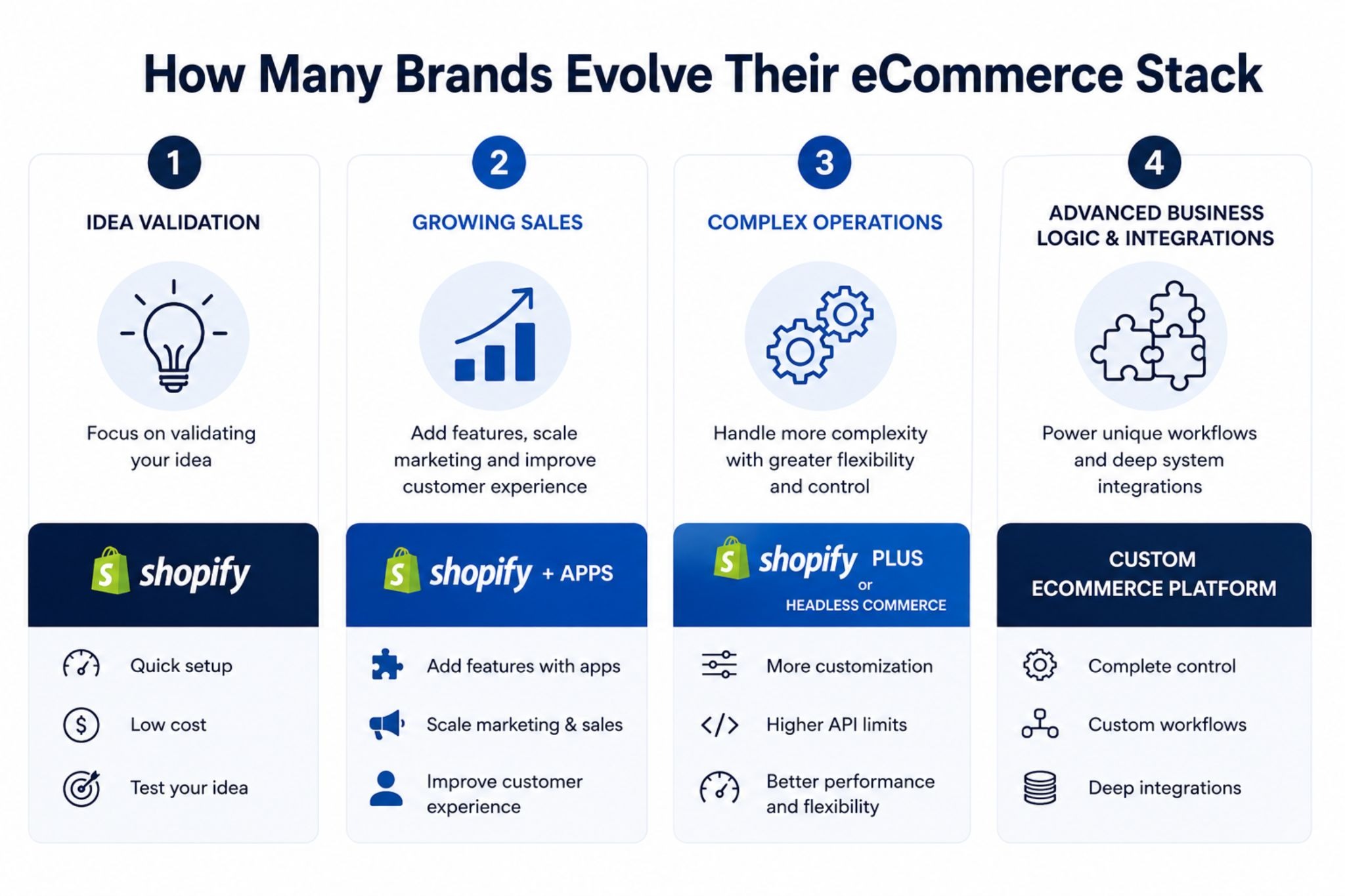
What If You Need Both? (Headless Commerce)
Many growing brands keep Shopify running in the background; it handles inventory, orders, and payments, and the team already knows how to use it. But the storefront customers actually see is custom-built.
This setup is called headless commerce. You get Shopify's reliability without being stuck with its theme and checkout limits.
It's more work than a normal Shopify store, and you need a team that knows both Shopify's backend and modern front-end development. That's what a specialist shopify web development company is built for, not a quick theme change.
This path is common for brands that started on Shopify, outgrew the storefront, but don't want to rebuild their entire order system.
If you're in retail and thinking about this kind of setup, choose the right e-commerce development company, one that can put Shopify in the back and something stronger up front.
So, Which One Should You Actually Choose?
Choose Shopify if you're:
Launching a new brand or testing a product line
Selling a fairly standard catalog to consumers
Working without a dedicated in-house dev team
Prioritizing speed over long-term flexibility
Choose Custom eCommerce if you're:
Running complex B2B pricing, configurators, or multi-warehouse logic
Outgrowing what apps and workarounds can fix
Integrating deeply with an existing ERP or CRM
Building something investors or regulators will scrutinize closely
There's no prize for picking the more impressive-sounding option. The businesses that get this right choose based on where they actually are, not where they hope to be in three years.
Still Weighing It Up?
That's normal; this isn't a decision to rush. If you want a second opinion on where your business actually sits.
Tell us what you're building, and we'll give you a straight answer on whether Shopify, custom, or headless actually fits.
FAQs
Can I move from Shopify to a custom site later?
Yes, you can. The important part is planning the migration well, so your SEO rankings and customer data make the move with you instead of getting lost along the way.
Does Shopify limit my SEO?
To some extent, yes. You don't get full control over your URL structure, and running too many apps can slow your site down. Both of those affect how well you rank.
What is headless commerce, in plain terms?
It's a setup where Shopify quietly handles the backend: orders, inventory, and payments, while a custom-built front end is what your customers actually browse and shop on. You get Shopify's reliability with a storefront built exactly the way you want it.
Is Shopify Plus the same as a custom build?
Not quite. Plus removes some restrictions and gives you more checkout flexibility, but underneath it all, you're still working within Shopify's platform.
Which one is better for a brand-new business?
For most new businesses, Shopify is the better starting point. Getting to market fast matters more early on than having complete platform flexibility.

What Is AI Integration and How Can It Actually Help Your Business in 2026?
In 2026, the biggest business risk isn't failing to adopt AI. It's adopting AI the wrong way.
Here we’ll see what that actually looks like in practice.
A business owner sees competitors talking about AI. The budget gets approved. A tool gets purchased. The team uses it a few times, then stops. Six months later, nothing has changed except the invoice. Leadership quietly agrees, "AI wasn't right for us yet," and moves on.
Most people blame the technology. The real problem was never the AI. The real problem was that nobody agreed on what problem it was supposed to solve.
So What Does "AI Integration" Actually Mean?
Your business already runs on a set of workflows, like how orders get processed, how customers get supported, and how your team reports on performance. AI integration means building intelligence directly into those workflows, so they get faster, smarter, and less dependent on manual effort.
Not a standalone tool that your team has to remember to open. Not a chatbot bolted onto your website. Something that works inside the systems you already use, on the data you already have.
When AI integration services are done right, you don't feel like you've added something new. You feel like you've finally fixed something that's been slowing you down for years.
Why Do So Many AI Projects Quietly Die?
Here's a number worth pausing on: 78% of businesses have adopted AI in some form. Yet 70–85% of those projects fail to deliver real, measurable results.
Because businesses are skipping the most important step, figuring out what they're actually trying to fix before buying anything.
The sequence matters more than the tool. Every time.
Most AI projects die because:
A tool gets purchased before a problem gets clearly defined
Nobody asks which workflows are actually eating the most time or money
The team uses it inconsistently, and it quietly gets deprioritized
The verdict becomes "AI didn't work for us."
Where AI Integration Actually Moves the Needle
Skip the theory for a moment, and here's where it shows up in real business scenarios.
Your Operations Team Is Doing Work a Machine Should Be Doing
Pick any back-office function: invoice processing, dispatch reconciliation, onboarding paperwork, or compliance reporting. Somewhere in your business, smart people are spending hours every week on tasks that follow a predictable pattern.
Automation for businesses at this level isn't glamorous. But it's where the ROI shows up the fastest. Companies that automate even one high-volume workflow typically cut processing time by 30–50% within the first quarter.
A real scenario: A logistics company was spending 12 hours a week manually reconciling dispatch records. After AI automation, it ran overnight. Flagged exceptions landed in a human reviewer's inbox each morning. The team didn't notice the change in workload; they noticed it in their calendar.
Your Customer Support Can't Keep Pace With Growth
Your team is capable. But they can only handle so many conversations at once. As your business grows, the gap between what customers expect and what your team can deliver gets wider and more expensive.
Generative AI integration enables you to deploy intelligent support systems that handle high-volume, low-complexity queries, such as order status, FAQs, and escalation routing, allowing your team to focus on the conversations that require judgment and empathy.
This isn't a generic bot that frustrates customers. It's a system trained on your products, your tone, and your actual customer history. The difference is noticeable from the first interaction.
You're Making Big Decisions on Yesterday's Data

Most founders and CEOs are running on reports that are 48–72 hours old by the time they read them. By then, the window has often already closed.
AI software development can embed predictive intelligence directly into the tools your team already uses, flagging risks before they become crises and surfacing demand signals before your competitors act on them. You stop being reactive. You start moving first.
You Want to Grow Revenue Without Growing Headcount at the Same Rate
With the right business AI solutions in place, your business can handle more customers, more transactions, and more operational complexity without hiring proportionally to match. The AI absorbs the volume. Your people handle what needs human judgment.
Nobody gets replaced. You just stop hiring people to do things machines do better.
The Mistake That Costs Business Owners the Most
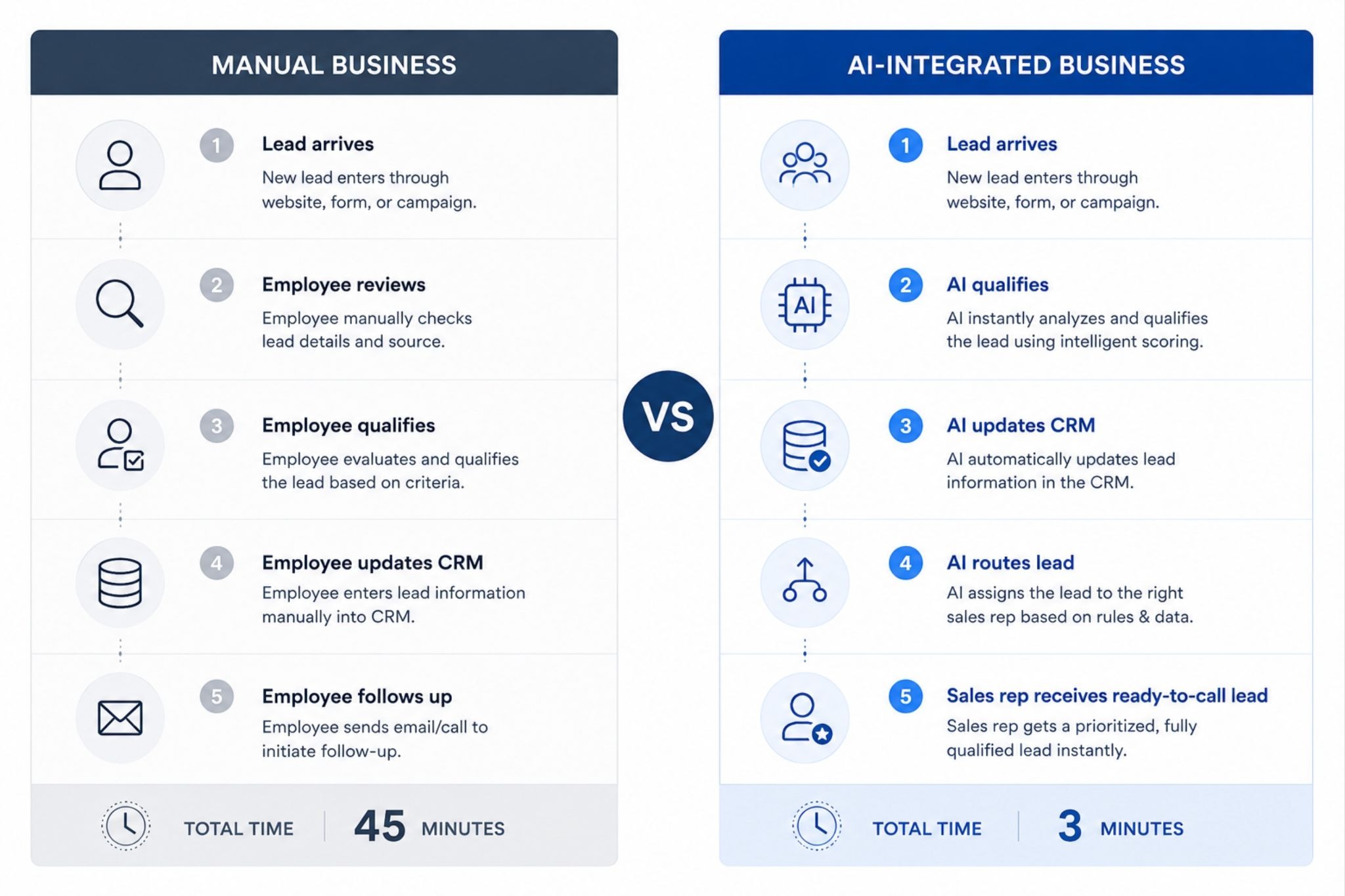
Confusing an AI tool with AI integration.
A tool is something your team logs into when they remember to. Integration is something that runs inside your business, whether anyone thinks about it or not.
Subscribing to an AI writing platform is a tool. Building an intelligent system that scores your inbound leads, routes them to the right sales rep, and updates your CRM automatically, that's integration.
True AI integration services connect to your existing stack, learn from your actual data, and operate inside your real workflows.
Before committing budget to any AI initiative, answer these three questions honestly:
What specific problem are we solving?
Which team or workflow owns that problem?
How will we measure success in 90 days?
If any of those answers are vague, you're not ready to build yet. You're ready for a strategy conversation first.
What Before and After Actually Look Like
Here's an honest snapshot across three common business functions:
None of this requires a year-long transformation project. It starts with one workflow. You prove the ROI. Then you expand.
What Role Does Generative AI Actually Play Here?
Generative AI is one layer within the broader AI integration stack. And probably the most overhyped one right now.
Used carefully, generative AI integration helps your business produce content at scale, build internal knowledge tools, generate smart document summaries, and create personalized customer communications, without a team of writers doing it all manually.
But without a clear scope and proper governance, it becomes expensive noise fast. The businesses seeing real results from generative AI aren't the ones who deployed it the fastest. They're the ones who scoped it the most carefully.
A broader look at why enterprise leaders are investing in AI software development in 2026 is worth your time.
How to Start Without Burning a Budget
Keep it specific. Keep it small. Measure everything.
Step 1 - Find your most painful workflow. The one that's quietly eating hours every week across your team.
Step 2 - Define what success looks like. Hours saved. Cost per transaction. Error rate reduced. Pick one number and commit to it before you start.
Step 3 - Build a focused solution. A targeted fix for the specific problem you identified in step one.
Step 4 - Measure for 60–90 days. If it works, expand. If it doesn't, adjust before you scale the wrong thing.
If you want a clearer picture of the consulting-first approach before committing to a build, this guide on how AI consulting services help businesses save time and reduce costs is a practical starting point.
And here's where the partner you choose matters.
Anyone can build something and hand it over. The question is whether they're still invested six months after launch, when the real-world edge cases show up, and the initial scope needs to evolve.
At Softuvo, we start with strategy before we write a single line of code. Because software built without a clear outcome in mind almost always needs to be rebuilt.
Have a workflow in mind? Let's talk about it.
FAQs
Q: Is AI integration only for large enterprises?
Not at all. You don't need to be enterprise-scale to benefit; you just need a real problem worth solving.
Q: How long before you see results?
A well-scoped integration can go live in 6–12 weeks. Larger programs typically run 3–6 months in phased rollouts.
Q: Does AI integration replace your existing software?
Usually not. Most integrations are built to connect with what you already use: your CRM, ERP, helpdesk, or finance tools. It adds intelligence to them, not a replacement layer on top.
Q: What's the real difference between automation and AI integration?
Traditional automation follows rules you set in advance. AI integration learns from your data, adapts when things change, and handles exceptions that would break a rule-based system.
Q: How do you know if your business is ready?
If you have a repeated pain point, data that tracks it, and a team that's open to working differently, you're ready to start. You just need a clear problem and the honesty to name it.

How to Choose a Mobile App Development Company the Right Way
Building a mobile app is a significant investment for any business. Just assume you hired a development company, and six months later, you get a half-built app, a drained budget, and the vendor has gone silent.
It's one of the most common and expensive mistakes businesses make. And the worst part? It's almost always preventable. However, with thousands of development agencies and freelancers offering app development services worldwide, finding the right partner can be challenging.
The goal of this blog isn't to give you a generic checklist. It's to show you exactly where businesses go wrong and how to avoid them before you sign anything.
Why Choosing the Right Development Partner Matters
Missed deadlines, unexpected costs, poor communication, and low-quality code are some of the most common issues businesses face when working with inexperienced or unreliable vendors.
It's rarely the idea or even the technology.
It's about choosing the right mobile app development company, not the one that only knows how to win a contract but doesn’t know how to deliver a product.
Most businesses compare vendors on price and presentation. That's how you end up with a team that looked great in the proposal and disappeared after the first payment.
A reliable development partner will not only build your application but also help you make informed decisions throughout the development process.
6 Red Flags to See When Looking for the Right Mobile App Development Company
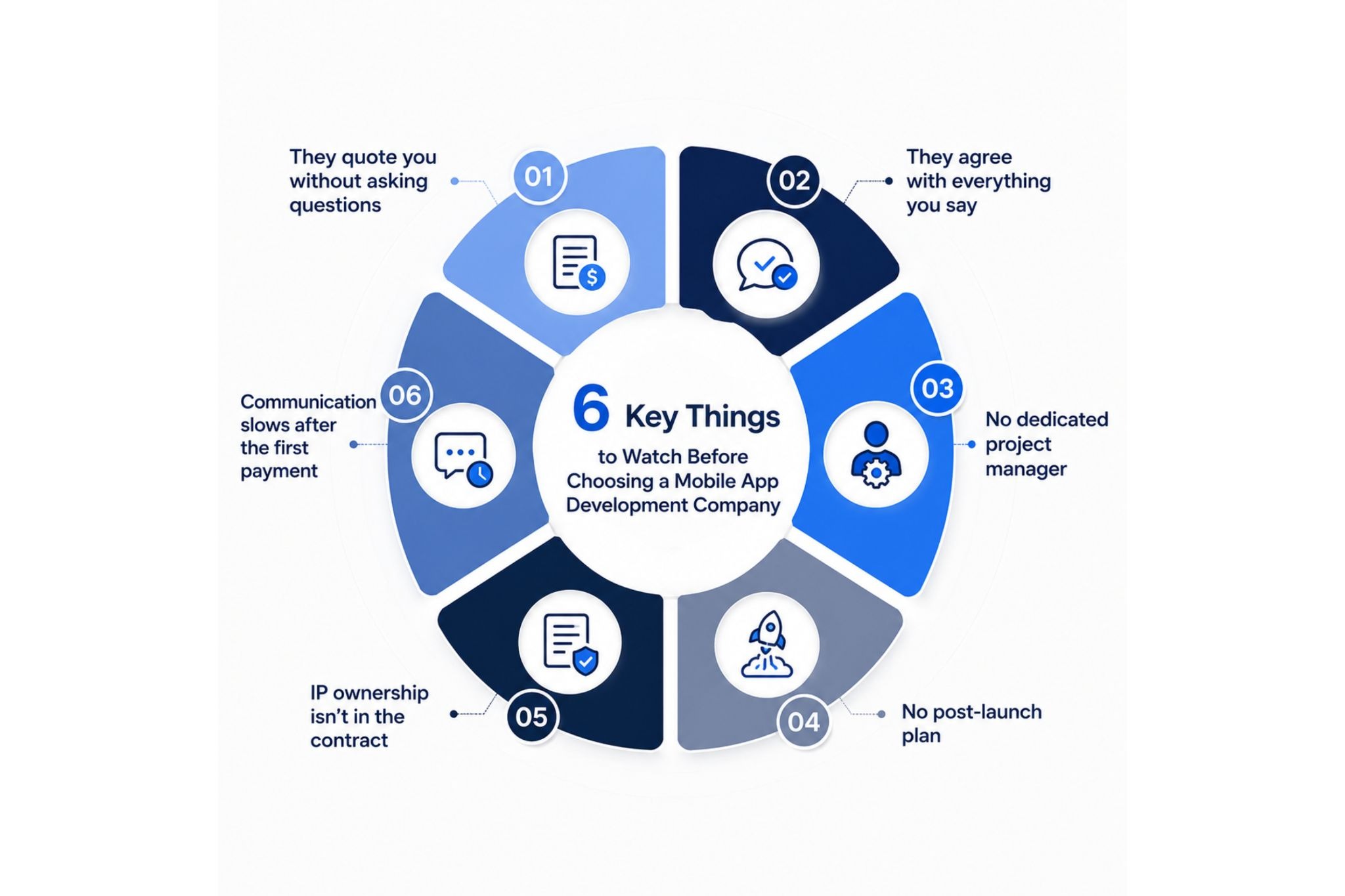
1. They quote you without asking questions
If you get a detailed price within 24 hours of your first email, with no discovery call and no questions about your users or integrations, that's a template, not a quote. The real number will surface after you've already paid a deposit.
2. They agree with everything you say
A strong app development firm pushes back. They'll say, "That feature adds six weeks, and users may not need it; here's what we'd suggest instead. " A team that never challenges your brief isn't being helpful. They're avoiding hard conversations that will become your problem later.
3. No dedicated project manager
If the developer is also your project manager, your account manager, and your point of contact, things will break. You need one person whose only job is to keep the project on track and communication clear.
4. No post-launch plan
Your app will need updates after launch. OS changes, bug fixes, and new features. If post-launch support isn't mentioned early, it either doesn't exist or costs a fortune later. Ask specifically: What's included after go-live?
5. IP ownership isn't in the contract
Who owns the code when the project is done? It should be you, explicitly, in writing. If a vendor hesitates on this or uses vague language like "you'll have access to deliverables," walk away.
6. Communication slows after the first payment
This is less a red flag and more a fire alarm. Set communication expectations in writing before any money moves. A professional team welcomes this.
Questions That Reveal More Than Any Proposal
Most people ask vendors what they can do. The better questions reveal how they actually work.
"Tell me about a project that went over budget or launched late."
Every honest team has one. How they talk about it tells you everything about their accountability and client relationships.
"How do you handle scope changes mid-project?"
Scope creep is the #1 cause of cost overruns. You want a defined process, not "we're flexible."
"Can I speak directly to two past clients?"
The references they hand you are curated. Ask to reach out independently to clients with similar projects. Confident teams say yes immediately.
The Hidden Cost of "Cheap" Development
Choosing the lowest bid is one of the most expensive decisions you can make.
A $15,000 app built by the wrong team often requires $50,000+ in rework within 18 months, not because features stop working, but because the architecture can't scale and the code isn't maintainable.
Add security vulnerabilities. In regulated industries like healthcare or finance, a data breach costs far more than the original development budget ever was.
The real calculation isn't cheap now vs. expensive now. It's cheap now vs. catastrophic later.
If the budget is genuinely tight, build a leaner MVP, but invest in solid architecture from day one. Everything you build later sits on that foundation.
Things to Consider When Working with an Offshore Team
When businesses look to hire mobile app developers globally, offshore teams offer real advantages, accessing deep talent at significantly lower cost. But offshore engagements fail for predictable reasons, and most of them are avoidable.
Time zone overlap matters. A 4–5 hour overlap is workable. Zero overlap means every decision takes 24 hours. That adds up fast over a 6-month project.
Test before you commit. Run a 2-week paid discovery sprint before signing a full development contract. You'll learn more in those two weeks than in ten sales calls.
Verify data compliance. If your app handles user data, and almost every app does, your vendor needs to understand GDPR, CCPA, HIPAA, or whatever applies to your users' markets. They should bring this up. If they don't, you should.
How to Make the Final Call
After shortlisting, here's what actually matters:
Technical fit: Have they shipped real products using your required tech stack?
Process clarity: Can they walk you through their development process without being vague?
Honest communication: After every meeting, do you feel clearer or more confused?
Verified references: Have you spoken directly to past clients, independently?
Clean contract: IP ownership, milestone-tied payments, change management, post-launch support. All of it, in writing.
Taking the time to evaluate vendors carefully may feel slow at the beginning, but it's far less expensive than fixing a failed project later. The right partner helps reduce risk, accelerate development, and build a product that can grow with your business.
Final Thought
The best app development companies don't just execute a spec. They ask better questions than you do, flag risks before they become problems, and treat the launch as a starting point.
That kind of partnership doesn't come from the cheapest proposal. It comes from doing the diligence upfront.
Ready to have the conversation?
If you're evaluating development partners and want guidance on your project requirements, timeline, or technology stack.
FAQs
How long does it take to build a mobile app?
Simple MVPs take 2–4 months. Mid-complexity apps take 4–8 months. Enterprise platforms can take 12+ months. Be skeptical of anyone promising a complex product unrealistically fast.
Fixed-price or time-and-materials contract: which is better?
Fixed-price works when requirements are clear and stable. Time and materials is better when the scope is likely to evolve. Neither is universally right; it depends on how defined your project is at kickoff.
How do I protect my idea before sharing it with a vendor?
Request a mutual NDA before sharing detailed specs. Any legitimate team will sign one without issue.
How do I know if a company is genuinely one of the best app development companies or just good at marketing?
Ask for independent references. Ask to see apps live in production. Have a real technical conversation with the engineers, not just the sales team. Marketing is easy to polish. Diligence reveals the truth.

10 Reasons Why Enterprise Leaders Are Investing in AI Software Development in 2026
Two years ago, investing in AI software development was a smart move. Today, it's a survival decision.
In 2026, enterprise leaders aren't just talking about AI; they're writing cheques for it.
Global AI software spending crossed $300B in 2025 and is still accelerating.
McKinsey reports that 88% of companies have now embedded AI into at least one business function.
The shift has already happened. Here are the 10 reasons driving enterprise investment in AI right now.
1. AI Software Development Delivers Measurable ROI

The cost of building intelligent software has dropped. The ROI has become measurable. And the excuses have run out.
CFOs who once asked, "Where's the proof?" are now asking, "Why haven't we started yet?"
Enterprises are cutting operational costs by 30–50% in targeted workflows.
AI software development ROI typically pays back within 6–9 months of deployment.
2. AI-Assisted Software Development Accelerates Delivery
They changed how software gets built, not just how hard their teams work.
Agentic AI solutions autonomously plan, write, review, and iterate on software, compressing 6-month builds into weeks.
Engineering teams using AI-assisted pipelines ship 40% faster with fewer post-launch defects.
Gartner predicts 80% of enterprise software engineers will use AI coding assistants daily by 2027.
3. Early AI Adoption Creates Long-Term Competitive Advantage
In 2023, AI adoption was a differentiator. In 2026, it's a baseline.
Enterprises that invested in enterprise AI solutions two years ago have already compounded those gains: lower costs, faster teams, and sharper decisions. That's not a gap you close in a quarter.
Every quarter without movement is a quarter your competitors bank.
4. AI-Powered Personalization Drives Enterprise Growth
B2B and B2C customers expect personalized experiences in 2026. The enterprises delivering it at scale are winning disproportionate market share.
Generative AI for enterprises powers dynamic pricing, intelligent onboarding, and adaptive dashboards across millions of customers simultaneously.
5. Your Data Is Already Telling You Something. AI Helps You Hear It.

Most enterprises are still making decisions on reports that are days old by the time they reach the boardroom. AI changes the operating rhythm entirely.
Predictive analytics built into enterprise software development helps leaders forecast demand, flag risk early, and move before competitors do.
Exploring AI for your enterprise?
Softuvo builds custom AI platforms for logistics, healthcare, and finance. See what we've built.
6. The Workflows Eating Your Team's Time? AI Handles Them Now.
From HR onboarding to finance reconciliation to logistics dispatch, AI automation platforms manage full workflows end-to-end. No fatigue. No handoff errors. No 9-to-5 constraint.
Enterprises report a 60–70% reduction in process cycle time after AI automation.
Start with one high-volume workflow. The ROI it delivers makes the next investment easy to justify internally.
7. AI Strengthens Enterprise Cybersecurity
Phishing, supply chain attacks, identity fraud, the threat landscape is moving faster than human teams can track alone.
AI monitors thousands of signals simultaneously, flags anomalies in milliseconds, and responds before a breach escalates. Softuvo's own YourDMARC is built on exactly this principle.
8. You Can Scale the Business Without Scaling the Headcount
More customers. More data. More transactions, but not necessarily more people.
When software handles routing, summarisation, monitoring, and decision support autonomously, you grow revenue without growing costs at the same rate. AI software development breaks the traditional growth equation.
10x output. Not 10x salary costs.
9. Compliance Doesn't Have to Be a Quarterly Fire Drill
For regulated industries, healthcare, financial services, and cross-border operations, the compliance burden is growing. AI-embedded enterprise software development keeps enterprises continuously compliant, not just at audit time.
AI flags violations in real time and auto-generates audit trails, no manual chasing required.
AI compliance tools can reduce audit preparation time by up to 50%.
10. The Best Talent Follows the Best Technology
The engineers and product leaders shaping the next decade of your business have preferences about where they work, and those preferences favour AI-native environments.
Investing in generative AI for enterprises isn't just a product decision. It's a talent strategy.
Benefits of AI Software Development for Enterprises
Unified Intelligence: Turns siloed data into a connected intelligence layer across the entire organization.
Faster Execution: Shortens the gap between strategy and execution; decisions move from insight to action faster.
Fewer Costly Errors: Reduces human error in high-volume, high-stakes processes without removing human oversight.
Software That Evolves: Creates software that improves over time, unlike traditional systems that degrade without maintenance.
Bigger Output, Leaner Teams: Gives smaller enterprise teams the output capacity of a much larger organization.
Consistent Experiences at Scale: Delivers consistent customer and employee experiences across every touchpoint, at any scale.
Real-World Use Cases Across the Industry Applications
Logistics & Supply Chain: AI dispatch routing, forecasting delivery delays, and optimizing fleet utilisation in real time more accurately than a full operations team.
Healthcare patient intake, insurance verification, and compliance flagging run automatically, reducing administrative overhead by 45% and letting clinical staff focus on patients, not paperwork.
AI solutions for financial enterprises identify fraud in milliseconds and automatically create audit-ready compliance reports.
Retail & eCommerce: Generative AI for enterprises personalizes recommendations, automates inventory forecasting, and manages dynamic pricing in real time.
Education & eLearning: AI personalizes course content to the behaviour of each learner, identifying where each user is struggling and adapting delivery accordingly.
AI vs No AI: What Enterprise Leaders Are Seeing
Final Thoughts
Enterprise leaders aren't investing in AI because it's trendy. They're doing it because the numbers are impossible to ignore: lower costs, faster outputs, smarter decisions, and a competitive edge that compounds over time.
The question for 2026 isn't "should we invest in AI?" It's "how fast can we move?"
The enterprises that will lead their industries in 2028 are making that decision today.
Whether you're starting from scratch or scaling an existing platform, the right AI software development partner makes that journey significantly shorter.
Ready to Build Your Enterprise AI Platform?
Softuvo helps businesses build smarter, from agentic systems to full-scale enterprise platforms.
FAQs
Q1. What is AI software development?
Building software that learns, adapts, and automates, using machine learning, NLP, or agentic AI, rather than just executing pre-written rules.
Q2. Why are enterprises investing in AI now?
The ROI is no longer theoretical. Mature tooling, measurable results, and competitive pressure have made 2026 the tipping point.
Q3. What are Agentic AI Solutions?
AI systems that plan, reason, and act autonomously across workflows, well beyond chatbots or basic automation. See Softuvo's agentic AI work.
Q4. How long does an enterprise AI platform take to build?
A focused MVP in 6–12 weeks. A full platform in 3–6 months, with value delivered in phases, not just at the end.
Q5. Which industries see the strongest AI ROI?
Logistics, healthcare, financial services, retail, and manufacturing, with high volume, high complexity, and significant manual overhead, make the gains substantial.

7 Ways AI Consulting Services Help Your Business Save Time and Reduce Costs
Many businesses don't struggle because of a lack of effort. They struggle because the way work gets done hasn't kept up with growth. As operations expand, repetitive tasks multiply, systems become disconnected, and teams spend more time maintaining processes than improving them.
Tools are also not aligned, and decisions are made on old information. And everyone is so busy keeping things moving that no one has the time to step back and fix any of it.
But now, AI consulting services reduce the complexity that's been slowing down your business. AI offers enormous potential, but implementation isn't always straightforward. In this article, we'll explore the common challenges businesses face with AI, what AI consulting services involve, and how they help organizations achieve measurable results.
Why Do So Many Businesses Struggle With AI?
According to Fullview AI Statistics, 78% of businesses have adopted AI in 2025, yet 70–85% of AI projects still fail to deliver real results.
The reason isn't that AI doesn't work, but most businesses jump straight into buying tools without a clear plan. They try something, and it doesn't work the way they hoped. And then the whole idea gets quietly dropped.
AI consulting services are built to solve this kind of problem. Instead of guessing, you work with experts who look at your business, figure out what will actually help, and make sure it works. Done properly, businesses have reported cost savings of 26–31% across customer support, finance, and day-to-day operations.
What Are AI Consulting Services, Exactly?
AI consulting services involve a team of experts who analyze how your business runs, find where you're losing time or spending too much money, and put a plan together to fix those things using AI.
A good AI consulting company will:
Listen first and understand how your business actually works
Spot the areas where you're losing the most time or money
Choose and set up the right tools for your situation
Make sure everything connects with what you already use
Support your team through the change so nothing gets disrupted
Think of it less like hiring a tech company and more like bringing in a trusted business partner who happens to know a lot about AI.
Ways AI Consulting Services Help Your Business
1. Automate Repetitive Tasks and Reduce Manual Work

Every business has tasks that happen on repeat, such as entering data, processing invoices, scheduling, managing documents, and sending the same emails. Each one feels small, but the hours add up quickly.
A business that eliminates just 20 hours of repetitive work each week can reclaim more than 1,000 productive hours over the course of a year from a single process alone.
Through AI development consulting, experts find where your team is stuck doing things that don't really need a human, then set up systems to handle those tasks automatically.
What gets better:
Fewer mistakes from manual data entry
Faster processing of invoices and documents
Your team is freed up for work that actually needs their thinking
2. Stop Letting Paperwork Eat Up Your Team's Best Hours
The more a business grows, the more internal paperwork piles up. People end up spending a big part of their day on things like:
Chasing approvals
Updating records
Writing the same kinds of emails
Pulling together reports that take hours to build
AI software consulting helps you set up smarter workflows where a lot of this happens on its own. Requests get sent to the right person automatically, and reports are ready when you need them.
Your team gets their time back, and they can use it on the work that actually moves your business forward.
3. Better Customer Support Without Bigger Costs
Customers today want quick answers at any time of day. Hiring more support staff to keep up with that is expensive and takes time to get right.
Generative AI consulting services offer a smarter way to handle this. With the right setup, AI takes care of the most common customer questions around the clock, things like:
Order updates and tracking
Booking and scheduling requests
Frequently asked questions
Basic troubleshooting steps
Your human team then focuses on the situations that actually need a personal touch. Among businesses using AI, 63% have seen revenue growth and 44% have seen lower costs in the same areas. Customer support is often where both happen at once.
4. Your Business Tools Finally Work Together
Most businesses run on a mix of tools that were never built to connect. The result?
Your sales system doesn't update your project tracker
Finance doesn't reflect what's happening in operations
Someone copies information from one tool to another every single day
A good AI consulting company builds connections between your systems, so information moves automatically within all the systems.
The unexpected bonus, far fewer internal meetings, because the information people used to gather in those meetings is already available to everyone.
5. Make Decisions With Confidence, Not Guesswork
Most business owners make decisions based on whatever information is available at the time, which is often out of date or spread across too many different places to be useful.
AI consulting helps you set up systems that bring all of your business information into one clear, up-to-date picture. You can see things like:
Which products or services are performing well, and which aren't
Where costs are quietly climbing
Which customers might be at risk of leaving
Where the biggest opportunities for growth are sitting
Better information leads to faster decisions, and faster decisions lead to fewer expensive surprises.
6. Get More Out of the Software You Already Have
A lot of businesses are running on software that's been around for years. It works, but it's slow, and it holds the business back from doing more.
In that case, legacy software modernization is a better path for most businesses. It:
Adds modern features to your existing systems
Connects them properly with the tools you use today
Automates the parts that currently need manual work
7. Build a Business That's Ready to Grow
The first six points fix specific problems, but this one is about what happens when those improvements work together over time.
AI-driven digital transformation means making AI a regular part of how your whole business operates.
When automation, smarter data, better customer support, and connected tools all work together, running and growing the business starts to feel easier.
Still thinking about what AI could do for your business?
Reach out to the Softuvo team.
Is Your Business Ready for AI Consulting?
You don't need to have everything figured out before talking to someone. But if several of these feel true right now, it's probably time:
Your team is stretched, but results haven't improved much
Customers are waiting longer than they should
You're making decisions based on information that's already old
Your software feels like it's working against you
You've looked at AI before, but weren't sure which direction to go
These are the signs that your business has grown past its current setup, and that's actually a good thing, because the solutions are more straightforward than most people expect.
How Softuvo Can Help
At Softuvo, every project starts by understanding your business and how it works before suggesting anything.
We work with businesses across healthcare, logistics, finance, retail, education, and technology. Whatever your industry, the approach is always built around what you actually need, not what's popular or easiest to sell.
FAQs
How quickly will I see results?
Most businesses see a difference within 30 to 60 days. A full return on investment typically comes within 6 to 12 months.
Do I need to replace all my current software?
Not necessarily. Legacy software modernization is designed to improve what you already have. A good consulting team will be honest about whether replacement is actually needed.
What makes AI consulting different from just buying AI tools myself?
Buying tools gives you software. Working with an AI consulting company gives you a plan and a proper setup.
Is this only for large businesses?
A small team of 15 people saving just 5 hours per person per week can reclaim almost 4,000 productive hours over the course of a year.
Which industries do you work with?
Healthcare, finance, retail, manufacturing, education, logistics, and technology. Every industry has different needs, and our work is always tailored to yours.
Why Trucking Companies Are Switching to AI Logistics Software for Smarter Fleet Management in 2026
The trucking industry moves $800 billion worth of freight every year in the US alone, and for decades, the people running those fleets managed manually.
But now, the fuel margins have gotten tighter. Driver turnover hit record highs. Customers started expecting Amazon-level tracking on a 40-ton semi. And suddenly, the systems that "worked fine" became the reason loads were being missed, trucks were sitting idle, and good dispatchers were burning out.
In 2026, more trucking companies are turning to AI logistics software to solve a very specific problem: their operations have outgrown the tools running them.
Why traditional fleet management is falling short in 2026
The old way of managing fleets was built for simpler times, smaller routes, manual logs, and a clipboard. Here's what's breaking down today:
Spreadsheet overload: Dispatchers are managing 20+ trucks on Excel
No fuel visibility: Without real-time monitoring, it silently drains thousands of dollars each month.
Disconnected systems: Nobody gets the full picture without manually stitching it together.
Reactive maintenance: Waiting for a breakdown before servicing a truck means driver downtime, missed loads, and unhappy customers every single time.
Zero demand forecasting: Without data, load planning becomes a guessing game.
No proactive customer updates: Customers calling to ask, "Where's my shipment?" is a symptom. The real problem is the absence of live, automated tracking built into your operations.
Quick stat: Nearly 30% of all commercial truck miles are driven empty. That's revenue your trucks could be earning on the return trip.
What AI logistics software actually does
AI logistics software is a platform that uses machine learning, real-time data, and intelligent automation to help trucking companies make faster, smarter decisions automatically.
Think of it as the difference between a paper map and live navigation. Both get you there, but only one knows about the accident on the highway before you reach it.
In practical terms, AI logistics platforms can:
Calculate the most fuel-efficient routes across dozens of stops in seconds
Flag a driver who's 20 minutes from an HOS violation before dispatch sends them another load
Forecast demand so you're never under- or over-resourced
Automate dispatch assignments based on driver availability, load weight, and route efficiency
Send automatic delivery updates to customers without your team lifting a finger
7 Reasons Trucking Companies Are Adopting AI Logistics Software
1. AI Route Optimization Cuts Fuel Costs Significantly
Fuel is 35–40% of a trucking company's operating cost. AI route optimization for trucking companies doesn't just find the shortest path; it factors in live traffic, delivery time windows, driver hours-of-service limits, and weight restrictions all at once. Companies using AI-driven routing consistently report fuel savings of 15–25% within the first year.
2. Predictive Maintenance Stops Breakdowns Before They Happen
Predictive analytics in trucking logistics uses vehicle sensors to flag potential failures days in advance, such as engine wear, brake degradation, and tire pressure anomalies. A single unplanned breakdown can cost $10,000–$20,000 when you factor in the tow, repair, and missed revenue. Catching it early costs a fraction of that.
3. Real-Time Fleet Visibility Replaces the Morning Scramble
With AI fleet management software, operations managers see every vehicle's location, driver status, load progress, and ETA live, not at the end of the day. Dispatchers stop spending hours assembling a picture of what's happening. They already know. That shift from reactive to proactive is one of the biggest productivity gains fleets report after switching.
4. Smarter Load Planning Eliminates Empty Miles
AI-powered load planning analyzes freight patterns and lane history to match available capacity with loads proactively. Some platforms surface backhaul opportunities automatically the moment a driver completes a delivery. Reducing empty miles by even 10% adds thousands of dollars monthly per truck.
5. Compliance Gets Automated, Not Missed
AI transportation management software monitors driver logs in real time, flags upcoming violations before they happen, and auto-generates audit-ready reports.
6. Customers Get the Transparency They Now Expect
Shippers and consignees now expect live tracking and proactive delay alerts. AI platforms automate customer notifications at every stage: picked up, in transit, approaching destination, and delivered. This alone reduces inbound "where's my shipment?" calls by 40–60% for most carriers.
7. Scaling From 10 Trucks to 100 Doesn't Mean 10× the Headcount
With traditional management, growing your fleet means proportionally growing your back-office team. With logistics software for trucking companies powered by AI, automation absorbs the volume. Dispatch, route planning, compliance, and customer updates scale with your fleet, without a new hire for every five trucks added.
Wondering where to start? Most fleets don't overhaul everything at once; they fix the most expensive problem first. See how Softuvo approaches it.
Common Concerns About AI Logistics Software
The benefits of AI logistics software are clear, but many trucking companies still hesitate before making the switch. Most concerns come down to cost, implementation, and adoption.
"Will it Be Too Expensive?"
Fair concern. But most fleets find the software pays for itself within the first year through fuel savings and fewer breakdowns alone.
"Will My Team Actually Use It?"
Dispatchers still dispatch. Drivers still drive. The difference is they're not spending 40 minutes figuring out the best route or manually logging HOS hours.
"How Soon Will We See Results?"
Many fleets start seeing improvements in route planning, fuel efficiency, and operational visibility within the first few months of implementation.
What Features Should Be in an AI Logistics Platform?
Not all platforms are equal. Here's what actually matters when evaluating your options:
Is AI Logistics Software Worth the Investment?
It requires real investment, but the more important question is, what does it cost you not to have it?
Here's what trucking companies typically see within 12–18 months:
15–25% reduction in fuel costs
40% less unplanned vehicle downtime
30% faster delivery turnaround
60% fewer inbound customer service calls
20% improvement in on-time delivery rates
And beyond the numbers, as your freight volume grows, the platform scales with it. You're not hiring a new coordinator every time you add five trucks.
How Custom AI Logistics Software Gives Trucking Companies a Competitive Advantage
Off-the-shelf platforms solve common problems, but your lanes, your customers, and your driver contracts are yours. A custom-built platform is designed around your realities, not what a vendor decided the average fleet needs.
What custom AI logistics software actually delivers:
Workflows that match how you operate: No forcing your team to adapt to someone else's software logic
AI trained on your data: Models built on your freight history deliver far more accurate predictions than generic industry datasets
No vendor lock-in: Your operational intelligence stays yours, not locked inside a SaaS platform's ecosystem
Seamless integration: Connects directly to your ERP, accounting tools, and carrier portals without patchwork workarounds. Softuvo's supply chain optimization approach is built on exactly this: one unified data layer
Softuvo has built custom AI logistics platforms for carriers and fleet operators, including Bridge18 (70–80% reduction in freight document processing time).
Explore Softuvo's logistics data and analytics capabilities to see how this translates to your operation.
If your operation has specific lane structures, compliance requirements, or customer SLAs, a platform built around those realities will outperform any generic tool over time.
Conclusion
This isn't just about new software. It's about how fleets stay competitive when the old playbook stops working.
The companies winning in 2026 aren't the ones with the biggest fleets. They're the ones whose fleets work smarter.
AI logistics software is the infrastructure behind that shift. If your operation is still running on spreadsheets, reactive maintenance, and disconnected systems, the gap is growing. The good news? You don't have to rebuild everything at once. The right partner helps you identify the highest-value problem first and build from there.
Talk to Softuvo's logistics tech team, no pitch, just a direct conversation about your operation.
FAQs
Q: What's the difference between AI logistics software and a regular TMS?
A TMS records and tracks. AI logistics software learns, predicts, and adapts; it spots problems before they happen and optimizes decisions automatically, not just after the fact.
Q: Is this only for large fleets?
No. Even a 10–15 truck fleet can see strong ROI from AI route optimization and predictive maintenance alone. The economics work at smaller scales today.
Q: How long does implementation take?
A focused solution typically takes 4 to 8 weeks, and if you want a full custom platform, it usually takes 3 to 6 months, depending on the complexity.
Q: Can it connect with our existing ERP or accounting software?
Yes. A well-built platform integrates with SAP, Oracle, Tally, QuickBooks, and others via APIs, with no manual data re-entry required.
Q: Custom vs. off-the-shelf, which is better?
Off-the-shelf works for standard operations. If you have specific lanes, customer SLAs, or compliance needs, custom is almost always the smarter long-term investment; you own the platform and the data.
Q: How does predictive maintenance actually work?
Sensors on your vehicle feed engine, brake, and tire data into an AI model. When the model detects warning patterns, it flags the vehicle for service before a breakdown occurs, turning emergency repairs into planned maintenance.

Laravel vs Node.js in 2026: Which One Should Your Business Actually Use?
Every business reaches a point where someone asks, "Should we build this on Laravel or Node.js?"
It sounds like a technical question, but for a business owner or CTO, it's really about three things: how fast can we ship, how much will it cost to maintain, and will it scale when we grow?
This blog answers exactly that for businesses planning modern enterprise web development projects. No deep code comparisons. No benchmark charts. Just a clear, honest breakdown to help you make the right call for your project between Laravel vs Node.js. We'll examine both technologies as tools that address distinct problems in various enterprise scenarios.
“Businesses evaluating Laravel or Node.js for business applications often focus on scalability, speed, and maintenance costs.”
What Are We Actually Comparing?
Laravel is a PHP framework. It comes loaded with built-in tools, user authentication, database management, background jobs, billing, email, and more. You start with a full toolkit and spend most of your time building your actual product.
Node.js is a JavaScript runtime. It's fast, lightweight, and incredibly good at handling things happening in real time, like live notifications, chat, or location tracking. However, unlike Laravel, it doesn't come with much built in. Your team assembles the stack from scratch.
Neither is better than the other in an absolute sense. They're built for different situations.
Where Laravel Wins for Enterprise
If your business is building something like a CRM, an admin portal, an ERP system, a SaaS platform, or an e-commerce solution, Laravel is very likely the right choice.
Here's why:
You ship faster
Laravel's built-in tools include authentication, role management, API endpoints, background queues, and billing. Your developers start building business features immediately instead of spending weeks wiring together third-party packages.
Real comparison: Building an equivalent SaaS foundation in Node.js typically requires integrating 8–12 separate packages before writing a single line of business logic. Laravel ships with all of that natively.
It's easier to maintain over time
Laravel enforces a consistent project structure. When a new developer joins your team, they can understand the codebase in hours, not days. For enterprise projects that run for 3–5 years with changing teams, this matters enormously.
Security is built in by default
Laravel automatically handles common vulnerabilities, SQL injection, cross-site scripting, and CSRF attacks out of the box. In industries such as finance, healthcare, or logistics, where compliance is non-negotiable, this approach significantly reduces risk.
The talent pool is large and cost-effective
Laravel developers are widely available, hiring is faster, especially across India, and senior talent is more accessible without the salary premium that specialist Node.js backend engineers often command.
Where Node.js Wins for Enterprise
Node.js can handle thousands of simultaneous connections without slowing down. This is because it processes requests through a single event loop rather than spinning up a new process for each one.
For most business applications, this makes no practical difference. But for specific use cases, it's a genuine game-changer.
Node.js is the right call when your product depends on:
Live tracking: delivery apps, fleet monitoring, logistics dashboards where location updates come in every few seconds from hundreds of drivers
Real-time messaging: customer support chat, team collaboration tools, or in-app notifications that need to push instantly
Live dashboards: operations rooms, financial trading interfaces, or monitoring panels that refresh in real time
High-concurrency APIs: when thousands of users are connected simultaneously and waiting for data
Example: You're building a delivery tracking app. Hundreds of drivers send location pings every 10 seconds. Thousands of customers are watching their order move on a map. That's exactly what Node.js was designed to handle. Laravel could do it, but you'd need significantly more infrastructure to manage those concurrent connections efficiently.
Node.js also makes sense when your entire team writes JavaScript. If your frontend is in React or Vue, using Node.js on the backend means one language across the whole stack, less context switching, easier code reviews, and simpler hiring.
Laravel vs Node.js: Which One Is Cheaper to Build and Maintain?
The part most blogs skip: Technology choice has a direct impact on your development cost and timeline. Here's what that looks like practically:
Still Unsure Which Stack Fits Your Product?
Choosing between Laravel and Node.js isn’t just a technical decision; Softuvo helps businesses choose the right technology architecture based on scalability, performance, development timelines, and long-term maintenance goals.
Four Questions to Help You Decide
Before you commit to either technology, run your project through these:
1. Does real-time functionality sit at the core of your product, or is it just a nice-to-have?
If it's core (live tracking, chat, instant updates), Node.js has a structural edge. If it's occasional, Laravel handles it fine with the right add-ons.
2. How fast do you need to go from idea to launched product?
If speed matters, and for most businesses it does, Laravel's built-in tools give you a meaningful head start.
3. What does your current development team know best?
Don't underestimate this one. A strong Laravel team will outperform a team learning Node.js on the job every single time.
4. Who's going to maintain the platforms two years from now?
If you're not sure, favor Laravel. Its conventions mean any competent PHP developer can pick it up without a long ramp-up.
What If You Need Both?
This is more common than people think. Many mature enterprise platforms use Laravel for the core application, the data layer, business logic, APIs, and reporting, and a lightweight Node.js service to handle the real-time layer (notifications, live feeds, WebSocket connections).
The two work well together, and it's an architecture we've designed and built for clients at Softuvo across logistics, retail, and fintech projects.
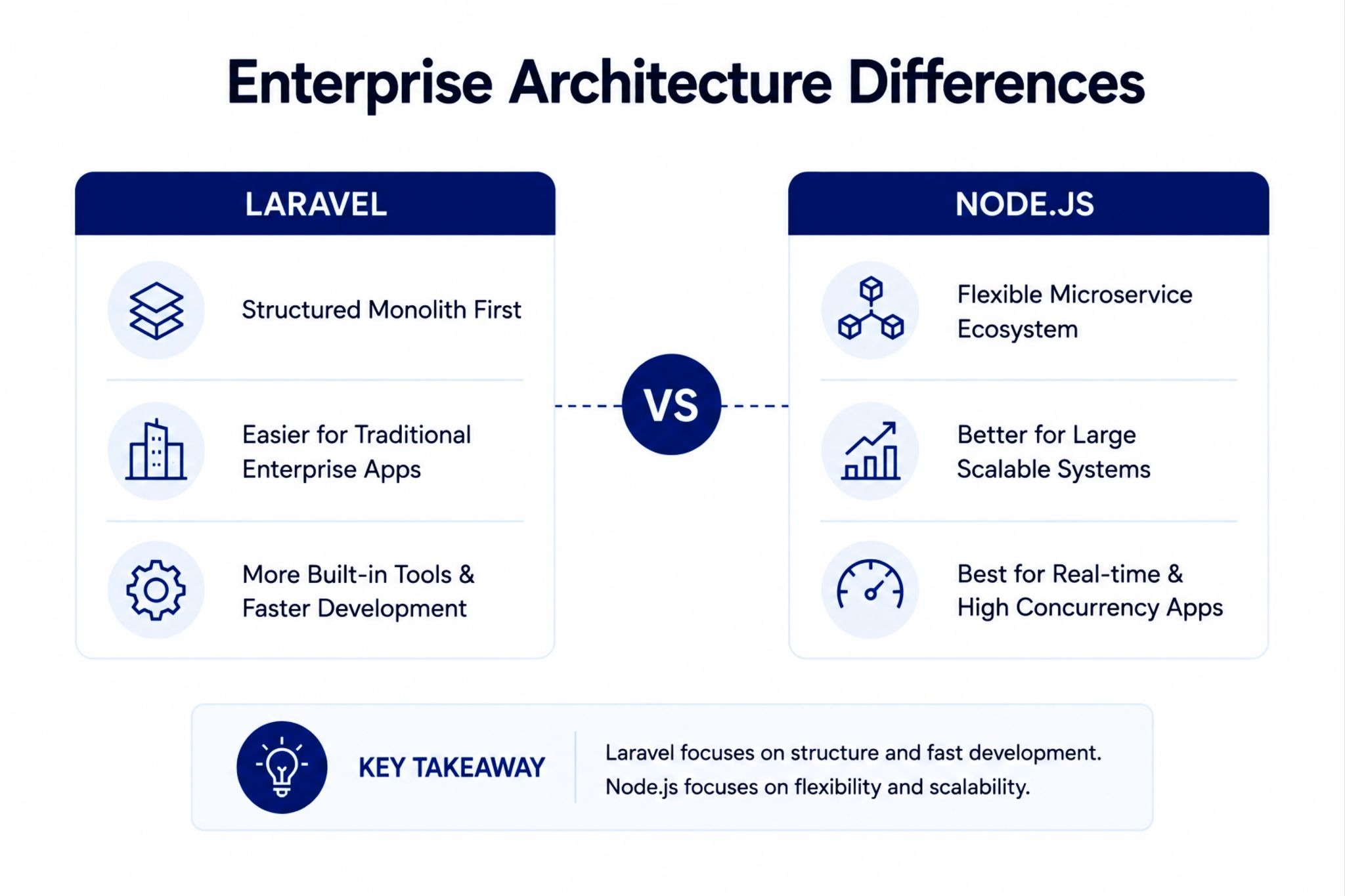
So, Which One Should You Actually Choose?
Having built enterprise software development projects across industries, our honest observation is this:
Most enterprise clients who come to us thinking they need Node.js actually need Laravel. The real-time features they're planning are either a small part of the product or can be handled well within Laravel's ecosystem, and they end up saving weeks of development time and thousands in budget.
The businesses that genuinely need Node.js are the ones where removing real-time would break the whole product.
Quick Cheat Sheet
Here’s a quick breakdown of which framework makes more sense based on the type of product you’re building.
Choose Laravel if you're building:
A SaaS platform or subscription-based product
A CRM, ERP, or internal business portal
An e-commerce platform with complex order management
A healthcare, finance, or logistics application with compliance requirements
Any product where speed-to-market is the top priority
Choose Node.js if you're building:
A live tracking or delivery monitoring application
A real-time collaboration or messaging tool
A high-concurrency API serving thousands of simultaneous users
A product where your full team is already JavaScript-first
Not Sure Which One Fits Your Project?
That's exactly the kind of conversation we have every week with business owners and CTOs at Softuvo.
For scalable enterprise applications, the best framework for enterprise web development ultimately depends on your product architecture, scalability goals, development timeline, and long-term maintenance strategy.
Not every project fits neatly into one box, and that's okay.
Talk to our team. No pressure, no jargon. Just a straight conversation about what technology actually makes sense for your business.
Or explore our services:
FAQs
Q1. Is Laravel still relevant in 2026?
Very much so. Its ecosystem has grown significantly with tools like Livewire, Filament, and Laravel Pulse, making it one of the most capable frameworks available today.
Q2. Is Node.js good for enterprise applications?
Yes, but for specific use cases, real-time features, live tracking, or high concurrency. For standard business apps like CRMs or portals, Laravel is usually the more practical choice.
Q3. Which is faster to build with?
Laravel. It ships with authentication, queues, billing, and APIs built in. Node.js requires assembling those from separate packages, which adds weeks before real development even starts.
Q4. Can a small team handle a Node.js enterprise project?
It's harder. Node.js demands strong architectural decisions upfront. Small teams generally move faster and stay organized with Laravel's built-in structure.
Q5. Which framework is easier to hire for?
Laravel. The PHP talent pool is large, especially across India, and hiring is faster and more cost-effective than finding a specialist Node.js backend engineer.
Q6. Can Laravel and Node.js work together?
Yes, and it's quite common. Laravel handles core business logic while a lightweight Node.js service manages real-time features like live notifications or WebSocket connections.
Q7. Which is better for a SaaS product?
Laravel. Cashier for billing, Sanctum for API auth, and Horizon for queues cover the core SaaS requirements without any extra setup.
Q8. Does framework choice affect maintenance costs?
Significantly. Laravel's consistent structure means new developers can onboard quickly. Node.js projects vary widely in setup, which can make long-term maintenance unpredictable and costly.
Why Dubai Startups Are Replacing Separate iOS and Android Teams With React Native App Development
Hiring separate iOS and Android developers for your Dubai startup in 2026 is like printing two newspapers for the same reader, which doubles the cost and doubles the effort, yet the destination is the same.
The most efficient startups in Dubai, from fintech ventures to logistics companies and retail tech businesses, have figured this out. They are building for both platforms simultaneously using React Native app development, launching faster and scaling without the overhead of running two parallel development teams.
In this blog, you will learn:
Why does running separate iOS and Android development teams slow down Dubai startups?
What React Native actually is and why it is not a compromise?
The five real advantages driving this shift
Which industries in Dubai are leading the adoption
What to look for when choosing a development partner
A clear cost comparison between the two approaches
Whether you’re a first-time founder considering your tech stack or a growing company ready to consolidate your mobile operations, this guide provides a comprehensive overview.
Quick Fact: Over 70% of businesses globally now prefer cross-platform development to reduce cost and time.
The Real Problem of Running Separate iOS and Android Development Teams
When you build native iOS and Android app development products separately, you are not just paying for two developers. You are paying for two complete development pipelines.
Here is what that actually means in practice:
Two codebases written in different languages: Swift for iOS, Kotlin for Android
Two QA cycles every time a new feature ships
Two separate bug reports after every Apple or Google OS update
Two teams that need to stay in sync without ever working in the same codebase
Two App Store submissions every time a fix or update goes live
The numbers tell the story: Building separate native apps costs 30–40% more than cross-platform development over the full product lifecycle. For a medium-complexity app, that gap can exceed $100,000.
And the price is not the only concern. Each feature takes twice as long to get off the dock, each update doubles the coordination overhead, and every new hire contributes to an inherently redundant structure.
The founders who have moved away from this model are not chasing trends: the math simply stopped working in the dual-team model's favor.
What Is React Native and Why Is It Not a Compromise?
React Native is an open-source mobile framework created by Meta (Facebook). It lets developers build apps for both iOS and Android using a single JavaScript codebase.
The most common misconception? That cross-platform means lower quality, but it does not.
React Native renders actual native UI components, not a web view, not a browser shell. iPhone users get a genuine iOS experience, and Android users get a genuine Android experience with the same codebase.
Global brands that trust React Native in production:
Spotify: Expanded React Native across their entire app in 2025, reporting a 35% faster development cycle and a 40% reduction in bugs
Discord: Saved 30% in development costs and achieved a 99% crash-free app
Shopify: Called it one of their best engineering decisions, citing dramatically faster feature delivery
Airbnb: Built and shipped major product features on React Native
These are not cautious bets by small companies. These are some of the world's most demanding mobile environments, and they chose React Native because it delivers.
Why Dubai Startups in Particular Are Making the Switch
Dubai's market has a unique set of conditions that make this shift especially compelling.
1. The UAE is mobile-first by default. The UAE has one of the highest smartphone penetration rates in the world. Your users are on both iOS and Android, which means launching only on one platform while building the other is simply not a viable strategy for most products.
2. Investors reward capital efficiency. In Dubai's competitive funding environment, founders who demonstrate they have achieved full mobile reach at 60% of the traditional cost.
3. Speed determines market position. The UAE government's digital transformation agenda creates market windows that open and close quickly. Startups that iterate faster capitalize first. React Native app development Dubai reduces total development time by up to 40%, which is not just a time saving, it is four additional months of user feedback, iteration, and market presence before competitors catch up.
4. Talent is easier to find and retain. Finding a senior Swift developer and a senior Kotlin developer in Dubai simultaneously is genuinely competitive. JavaScript developers, who power React Native projects, represent a much larger and more accessible talent pool, which means less time recruiting and lower hiring costs.
5 Advantages That Are Driving This Shift
1. One Codebase, Two Platforms Without the Double Budget
Up to 80–90% of code is shared between the iOS and Android versions of a React Native app. One team owns the entire mobile product, which makes communication simpler and sprints cleaner, and there is a single source of truth for every feature, fix, and improvement.
2. Faster Launch, Real Competitive Advantage
React Native reduces development time by up to 40% compared to sequential native builds. A startup that launches in five months instead of nine does not just save money; it gains four months of real-world traction before the competition catches up.
3. Leaner Teams, Unified Ownership
Cross-Platform Mobile App Development for Startups puts the entire mobile product under one team's ownership. No fragmented sprints, no duplicate onboarding, and no coordination overhead between two teams that speak different technical languages.
4. Bug Fixes That Ship to Both Platforms at Once
With separate native apps, a critical bug means two separate fixes, two QA cycles, and two App Store submissions. With React Native, you fix it once, and it deploys to both platforms simultaneously.
5. Lower Maintenance Costs That Compound Over Time
Annual app maintenance typically costs 15–20% of the original development cost. When your original cost is 30–40% higher because you built two native apps, maintenance scales in direct proportion; every OS update, every new feature, and every performance improvement costs twice as much to apply. React Native eliminates that compounding overhead.
Building an App for the UAE Market?
We have helped startups across the UAE launch on both platforms, faster and leaner than the traditional route. Let's talk about your app.
Industries in Dubai Adopting This Approach Fastest
Not every sector has adopted this shift at the same pace. The industries where the advantages are clearest have moved the fastest.
When React Native Is the Right Call and When It Is Not
To be completely straightforward: React Native is the right answer for the vast majority of commercial mobile applications. Industry analysis puts the proportion of apps that genuinely require native-only development at fewer than 10% of all commercial products.
React Native is a strong fit when:
You need to launch on both iOS and Android from day one
You are building an MVP and need to validate your idea fast
Your app involves standard UI patterns: dashboards, feeds, forms, booking flows, e-commerce
Budget and runway are real constraints
You want one team with unified ownership of the mobile product
Native development may be worth considering when:
Your app requires very deep hardware integration (advanced AR, specialized Bluetooth peripherals)
You are building a high-end gaming or real-time graphics application
Real-time computer vision or medical imaging at the pixel level is the core product
For the overwhelming majority of Dubai startups' consumer apps, SaaS platforms, delivery tools, fintech dashboards, and marketplace products, React Native app development delivers everything you need at a fraction of the cost and timeline.
The Cost Comparison, Side by Side
Real project example: A property management app built with React Native came in at $68,000. The same client received native development quotes of $115,000, a 41% cost reduction. The app runs successfully on both iOS and Android with maintenance costs exactly in line with initial projections.
What to Look for in a React Native Development Company in Dubai
Choosing the right React Native development company Dubai is just as important as the technology decision itself.
A portfolio of shipped, live apps: Look for applications on the App Store and Google Play with real users and visible ratings, not mockups, not prototype screenshots, and not case studies that stop at the design phase.
Domain experience in your sector: A company that has built fintech apps understands security architecture, compliance requirements, and financial data sensitivity. Healthcare app experience means understanding regulatory design from day one, not retrofitting it after launch.
Transparent process: Ask how they handle scope changes, what their sprint cadence looks like, and how they communicate progress. These answers tell you whether they treat you as a partner or as a client to be managed at a distance.
Post-launch support: React Native requires framework updates as Meta releases new versions. A quality development partner does not disappear after the app goes live. If a company frames launch as the finish line, that is a signal worth paying attention to.
Honest about limitations: Any company that tells you React Native is perfect for every use case without asking detailed questions about your product is selling you something. The right partner will tell you clearly where the framework fits and where it does not.
Ready to Build the Smarter Way?
Building a mobile app is a big decision, and the last thing you need is a development partner who sends you a templated proposal without understanding what you are actually trying to build.
At Softuvo, we delivered mobile products for startups and scaling businesses across the UAE and globally. If you are ready to build the smarter way, tell us what you are building and where you want to take it, and we will tell you honestly.
Discuss your app with our team
Or explore our mobile app portfolio to see the products we have shipped and the industries we have worked in.
FAQs
Will a React Native app feel native to my users?
Yes. React Native renders actual native UI components, not a web view. iPhone users get an iOS experience; Android users get an Android experience.
How much can my Dubai startup realistically save?
In simple terms, React Native typically saves Dubai startups 30 to 40 percent on the initial build. For a medium-complexity app, that is anywhere from $40,000 to $100,000 back in your budget.
Is React Native suitable for fintech or healthtech apps with UAE compliance requirements?
Yes, React Native fully supports encrypted storage, secure API communication, biometric authentication, and the data handling standards relevant to UAE financial and health regulations.
How long does React Native app development typically take?
An MVP typically takes 3 to 5 months with a focused team. A full-featured product with integrations generally ranges from 5 to 8 months.
Can I migrate my existing native app to React Native?
Yes, a gradual migration and full rewrite are also possible, depending on the size and condition of your existing codebase.
Do I lose anything technically by choosing React Native?
For most commercial applications, no. The only areas where native development still has a clear technical advantage are apps that require:
Very deep hardware or OS-level integration
Extremely high real-time graphics performance
Softuvo is a global technology partner with 9+ years of experience and 1,000+ clients worldwide, delivering mobile, web, and AI-powered digital solutions for startups and enterprises across fintech, logistics, healthcare, retail, and technology sectors. Recognised by Clutch, GoodFirms, AppFutura, and The Manifest as a leading mobile and web development firm.